

Every daily Wordle puzzle leaves behind valuable linguistic clues. While millions of players treat each morning’s puzzle in isolation, studying past Wordle puzzles, smart solvers treat the game as an evolving data set. Adopting an informed past Wordle puzzles strategy allows you to analyze historical trends, avoid burned solutions, and sharpen your pattern recognition for live play.
With more than 1,500 daily Wordle games officially completed since the game’s inception, the historical archive is no longer just a trivia list — it is a treasure trove of tactical intelligence. In this guide from Hintzo, we explore the official recurrence policy, how past solutions reveal editorial habits, and how you can use our verified archives to dramatically boost your solving speed.
Do Wordle Answers Ever Repeat? (The Official Recurrence Policy)
A central pillar of any past Wordle puzzles strategy addresses whether from daily solvers is: Can yesterday’s Wordle answer appear again? Does Wordle ever repeat words?
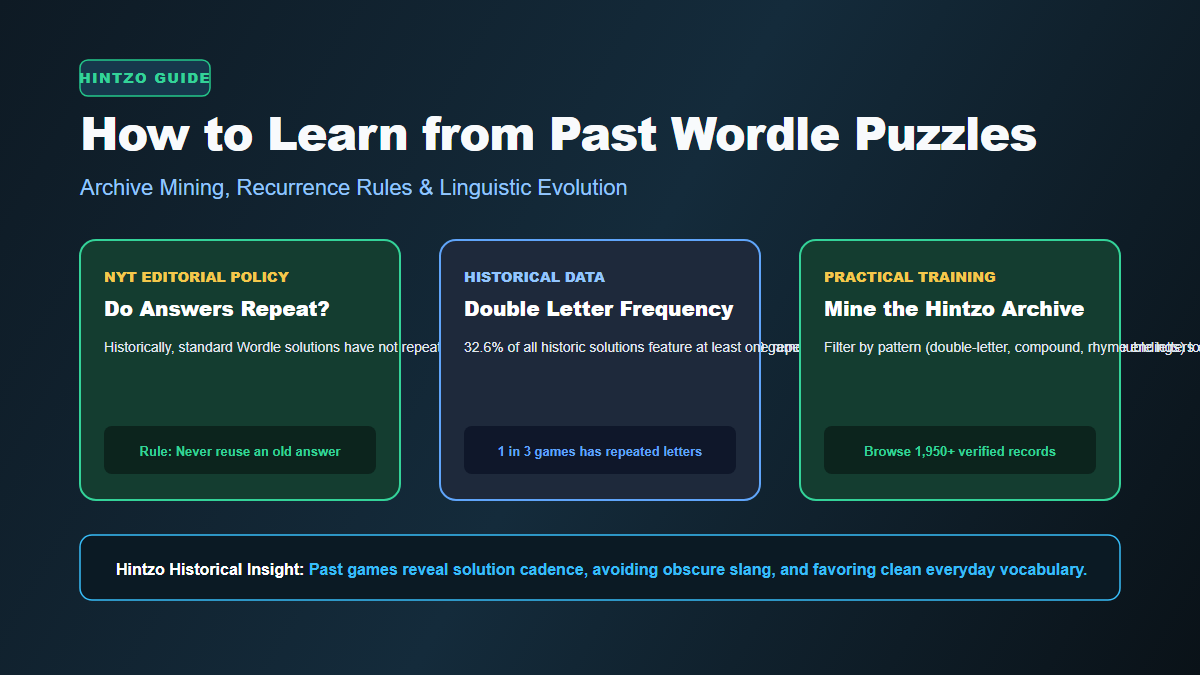
The short answer is: Historically, standard daily Wordle answers do not repeat.
When Josh Wardle created the game, he compiled an original curated list of 2,309 solution words, ordered in a deterministic daily sequence. Even after The New York Times acquired Wordle in early 2022 and appointed an official editor, the NYT games desk has maintained the practice of cycling through virgin words from the lexicon rather than recycling past solutions.
Official puzzle history published by The New York Times Games demonstrates how a disciplined past Wordle puzzles strategy keeps players ahead of editorial curveballs.
What 1,500+ Past Games Reveal About Wordle Solutions
A data-backed past Wordle puzzles strategy reveals powerful recurring patterns powerful recurring patterns that counter common player biases:
1. Double Letters Are Far More Common Than You Think
Many solvers subconsciously avoid guessing words with duplicate letters (like SWEET, SKILL, or OTTER) until forced to. However, statistical analysis of past puzzles reveals that 32.6% of all historic solutions contain at least one repeated letter.
That means roughly one out of every three daily games features a double letter! Solvers who resist testing duplicate letters consistently take 1.2 more turns to solve on double-letter days. Explore our Repeated Letters Guide for identification tips.
2. The NYT Favors Clean, Familiar Vocabulary
A common fear among newer players is that the answer might be an obscure, archaic dictionary term like XYLIC, QOPHS, or ZOWIE. Historical archive analysis completely debunks this fear.
While Wordle accepts over 12,000 valid English words as guesses, the 2,309 curated solution words consist almost exclusively of common, everyday vocabulary. If you are choosing between a common word like STOMP and an obscure word like STOAT, historical precedent overwhelmingly favors the familiar term.
3. No Simple Plural Nouns Ending in -S
Notice that past answers never include words like DOGS, CATS, BIRDS, or CARS. Simple four-letter nouns pluralized with an -S were excluded from the solution pool from day one. An S at the end of a past Wordle solution is almost always part of a root word (such as CHESS, GRASS, or FOCUS) or a third-person verb (such as GUESS).
The Top Linguistic Patterns in the Hintzo Archive
An effective past Wordle puzzles strategy categorizes previous solutions into linguistic taxonomies, players can recognize structural archetypes instantly during live play. Here is how past puzzles break down across our archive categories:
| Pattern Taxonomy | Historic Occurrence | Iconic Past Examples | Direct Archive Link |
|---|---|---|---|
| Double Letter Words | ~32.6% of games | ABBEY, CHEEK, GOOSE, SKILL | View Double Letter Archive |
| Compound & Root Words | ~14.2% of games | BLACK, FLUTE, STRAW, CLOUD | View All Solved Answers |
| Semi-Vowel (Y) Words | ~18.4% of games | DRYLY, FOAMY, LUCKY, PARTY | View Vowel Guide |
| Dangerous Rhyme Traps | ~11.8% of games | LIGHT, WATCH, ROUND, TASTE | View Word Traps Guide |
How to Analyze Past Wordle Puzzles in the Hintzo Archive to Train Your Intuition
Developing an elite past Wordle puzzles strategy means treating past games like grandmaster chess archives just like chess grandmasters study past games. Here is an effective 4-step training routine using the Hintzo tools:
- Review the Yesterday Recap: Each morning, check the Hintzo Homepage to review yesterday’s puzzle recap, difficulty rating, and vowel breakdown before attempting today’s board.
- Search Past Patterns: If you struggled with a specific word type (such as words starting with consonant blends like WH- or GL-), browse our pattern archives to familiarize yourself with how many five-letter solutions use that structure.
- Verify End-Game Candidates: In tough round-5 situations, use our search tools to check if one of your candidate words has already been used in a previous month.
- Track Monthly Trends: Our monthly archives (such as the October 2026 Wordle Archive) provide a calendar view showing difficulty fluctuations and pattern clustering over 30-day spans.
5 Practical Daily Habits Derived from Archive Study
1. Don’t Replay Old Answers: Never guess a word that was the official solution within the last year.
2. Expect a Double Letter Every 3 Days: If turns 1 and 2 yield sparse vowels, immediately consider repeated consonants or vowels.
3. Favor Common Everyday Words: When in doubt, pick the word an 8-year-old would know over an obscure Scrabble term.
4. Watch Suffix Frequency: Words ending in -ER, -ED, -LY, and -TY appear far more frequently than words ending in -IC, -UM, or -OX.
5. Respect the Traps: Rhyme traps happen regularly; keep a sacrifice escape plan ready as outlined in our Word Traps Guide.
Frequently Asked Questions
Will Wordle ever run out of words?
With 2,309 original words, a single game per day lasts roughly 6.3 years. Once the initial list concludes, The New York Times may add curated words or begin a second cycle. For now, non-repetition remains the operative standard.
Where can I see the complete history of Wordle answers?
You can browse every verified daily game from puzzle #0 to the present day in our searchable, spoiler-safe Hintzo Wordle Answers Archive.
How does difficulty vary over time?
Difficulty ratings depend heavily on consonant dispersion and trap potential. Puzzles with rare starting letters (like J, Z, or V) or heavy rhyme traps consistently average higher community guess counts.
Integrate your past Wordle puzzles strategy with our Wordle Letter Frequency Guide and Second Guess Strategy Guide.