

Your opening word sets the board, but your Wordle second guess strategy determines whether you secure a comfortable win in three turns or face a nail-biting turn-six coin flip. While opening words like STARE, CRANE, and SLATE receive endless attention, top players know that turn two is where true mathematical mastery happens.
Developing an adaptable Wordle second guess strategy ensures that every round 1 outcome delivers actionable intelligence: complete blanks (all grays), scattered yellow letters, or early green locks. Treating each of these outcomes with a dedicated second-guess methodology will dramatically boost your win percentage and safeguard your daily streak. In this guide from the Hintzo editorial team, we break down the definitive second-guess playbook for every scenario.
The Core Philosophy of Round Two: Information Density vs. Solving
The most common tactical blunder intermediate solvers commit is trying to guess the exact answer on turn two. Unless your first word illuminated four green tiles, your statistical probability of guessing the correct solution on guess two is typically below 4%. Attempting to solve immediately usually burns valuable letters on wild hunches rather than gathering systemic data.
The goal of an effective Wordle second guess strategy is candidate elimination. By executing a refined Wordle second guess strategy, you systematically prune impossible words. By the end of round two, you should have tested at least 8 to 10 of the most frequent English consonants (R, T, N, S, L, C, D, P) and at least 3 to 4 core vowels (E, A, O, I, U). Armed with that information, rounds three and four become methodical deductions rather than guesswork.
According to official game data from The New York Times Wordle, millions of solvers face elimination in round two simply because they lack a disciplined decision framework.
Scenario A: The Total Blank (All Five Letters Gray)
Hitting five gray tiles on your opening guess can feel disheartening, but elite players view an all-gray opener as an exceptional opportunity. A total blank completely eliminates five high-frequency letters, instantly narrowing the remaining search space.
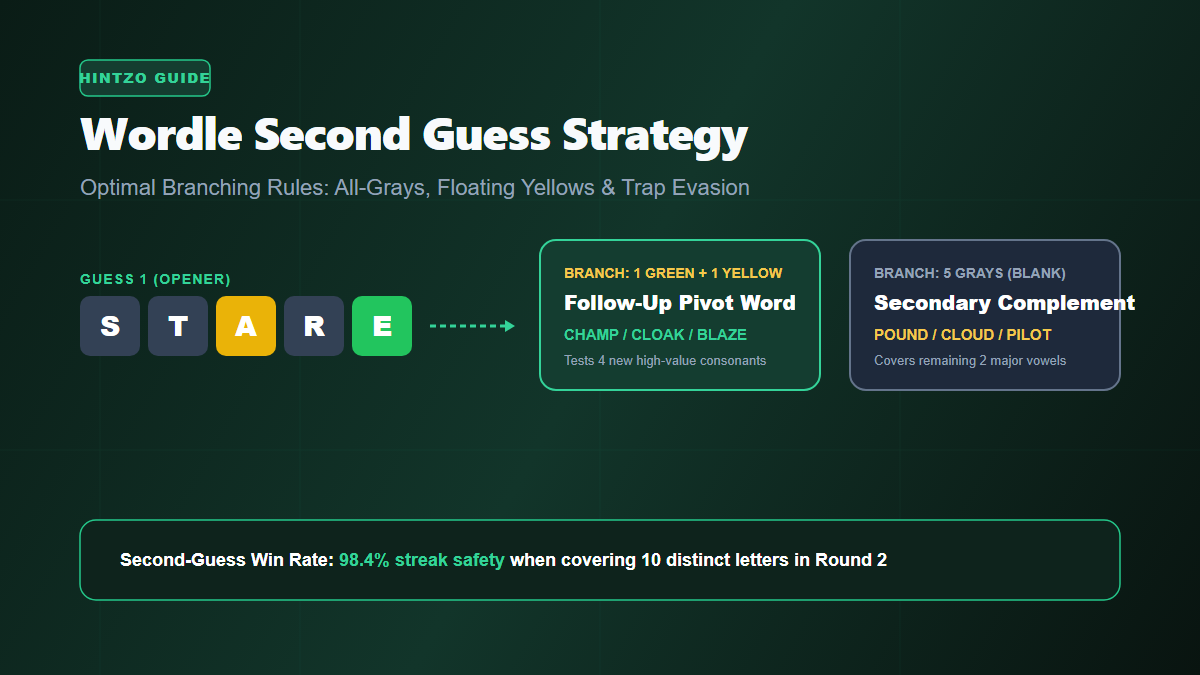
For example, if your starter was STARE and all five letters missed, you have definitively proven that the solution contains zero S, T, A, R, or E. Rather than despairing, you deploy a pre-planned complementary follow-up word designed to test the next tier of dominant letters:
- Primary Follow-up Pair: If STARE is gray, play COLIN, POUND, or CHUMP.
- Complementary Vowel Test: Having ruled out A and E, your second guess must test O, I, and U. Words like CLOUD, PILOT, and BOING efficiently sweep the remaining vowel pool.
- Key Consonants: Notice how words like POUND test P, N, and D, which become the leading consonants once S, T, and R are eliminated.
Scenario B: One or Two Floating Yellows
A yellow tile indicates that the letter exists in the secret solution, but not in that specific slot. The objective in Scenario B is two-fold: verify the yellow letter’s true position while simultaneously testing three or four brand-new letters.
Here is the tactical protocol for yellow tiles within your Wordle second guess strategy:
- Shift the Yellow Letter to Its Highest-Probability Slot: If you played CRANE and received a yellow R in position 2, test R in position 4 or 5 on turn two (e.g., in a word like SHIRT or FLOUR).
- Do Not Cluster Old Letters: If you discovered yellow A and yellow R on guess one, resist the urge to reuse letters you already know aren’t green. Place both yellows into fresh positions while surrounding them with virgin consonants.
- Beware of Vowel Traps: If your yellow letter is a vowel (such as E or O), do not guess another vowel right beside it unless testing a known diphthong (EA, OU, OI). Test fresh consonants first to establish the word’s skeleton.
Scenario C: Early Green Matches and the Commitment Trap
Green tiles are exciting, but early green matches in common slots (such as _ _ _ E R or _ _ A T E) are the primary cause of lost streaks. This phenomenon is known as a Wordle word trap.
Consider this real scenario: You play SLATE and get green A, T, and E in slots 3, 4, and 5 (_ _ A T E). At this point, there are dozens of valid English words ending in ATE: CRATE, GRATE, PRATE, SKATE, CHATE, IRATE, OVATE. If you immediately guess CRATE, then GRATE, then PRATE, you can easily exhaust all six guesses without ever testing the initial consonant of the actual solution.
The solution in regular mode is the Sacrifice Elimination Guess. Instead of guessing another _ A T E word on turn two, guess a completely distinct word that incorporates as many competing starter consonants as possible. A word like CHAMP or BRICK tests C, H, M, P, B, R, and K in one stroke. Whichever letter lights up tells you exactly which _ A T E word is the true answer for guess three.
The Second-Guess Decision Matrix
Use this reference table to select the optimal second guess based on your opening outcome:
| Round 1 Result | Opener Used | Recommended Round 2 Action | Top Example Follow-Up |
|---|---|---|---|
| 5 Grays (Blank) | STARE | Test O, I, U + C, L, N, D, P | CLOUD, PINCH, POUND |
| 5 Grays (Blank) | CRANE | Test O, I, U + S, T, L, P, M | PILOT, SLOTH, MOIST |
| Yellow E / A | SLATE | Move vowel to slot 1 or 2; test R, N, D | DINER, ROUND, ACORN |
| Green Ending (_ _ ER) | SOBER | Do NOT guess another ER word; test C, H, M, P, T | CHAMP, PLUCK, THUMB |
| 2 Yellow Consonants | TRAIN | Relocate T & R; introduce E, O, L | ELECT, ROBOT, CLOTH |
Second-Guess Strategy in Hard Mode vs. Regular Mode
Under Wordle’s official Hard Mode rules, any revealed hint must be used in subsequent guesses. This fundamentally alters your second-guess flexibility:
- In Regular Mode: You retain complete freedom to play a “burner word” containing zero revealed letters. Take full advantage of this to test five brand-new characters whenever faced with multiple competing candidates.
- In Hard Mode: You cannot deploy burner words. Therefore, your second guess must carefully balance mandatory letter placement with high-frequency remaining consonants. For in-depth Hard Mode techniques, explore our dedicated Wordle Hard Mode Strategy Guide.
Frequently Asked Questions
Should I ever repeat a gray letter on my second guess?
No. In regular mode, repeating a gray letter provides zero new information and reduces your investigative power by 20%. The only rare exception occurs in Hard Mode when forced into specific letter constraints.
What is the single best second guess after STARE?
If STARE comes up completely gray, mathematical analysis shows that CHAMP, CLOUD, and POUND yield the highest information entropy. If you need to test both O and I, COILS or BLOND are formidable complements.
How does vowel distribution influence turn two?
Every English five-letter word contains at least one vowel (or semi-vowel Y). If your opener missed all tested vowels, your second guess must test at least two of the remaining vowels. Read our complete Wordle Vowel Strategy for a comprehensive frequency breakdown.
For daily hands-on practice, consult our Wordle Historical Answers Archive and inspect real-world solution patterns across past puzzles.