

Vowels are the structural backbone of every English word, but how you handle them in Wordle often separates casual solvers from streak-protecting masters. A thoughtful Wordle vowel strategy ensures you never waste guesses chasing vowels while neglecting the vital consonants that actually identify the solution.
Many novice players mistakenly believe that finding all the vowels is the quickest route to victory. This widespread misconception has popularized vowel-heavy opening words like ADIEU, AUDIO, and SOARE. While discovering vowels is essential, linguistics reveals that consonants provide far higher discriminating power. In this guide from Hintzo, we explore the exact mathematical distribution of vowels, their positional habits, and the tactical rules for hunting them effectively.
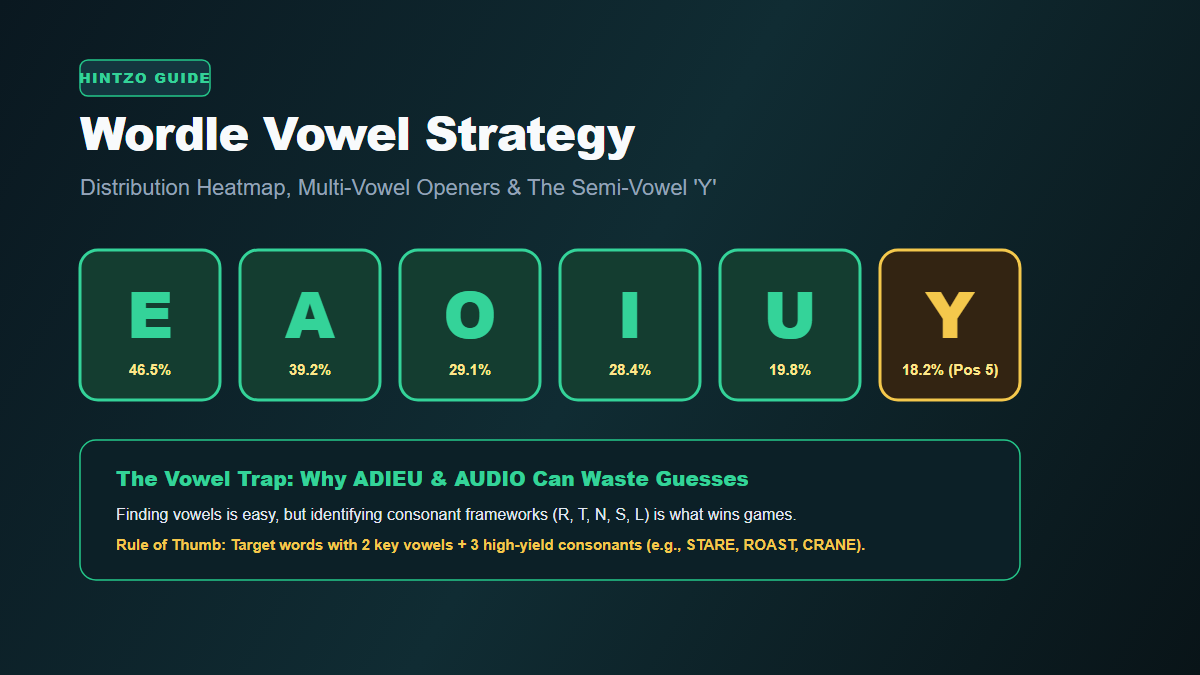
The Vowel Frequency Hierarchy in the Official Wordle Lexicon
The official Wordle solution dictionary comprises 2,309 five-letter words. Across this curated list, the five traditional vowels and the semi-vowel Y appear with widely varying frequencies:
| Vowel | Total Occurrences | % of 2,309 Solutions | Most Common Word Position |
|---|---|---|---|
| E | 1,233 | 53.4% | Slot 4 & Slot 5 (Silent E, -ED, -ER) |
| A | 979 | 42.4% | Slot 2 & Slot 3 (Central syllable core) |
| O | 754 | 32.7% | Slot 2 & Slot 3 (FLOAT, SHOCK, POINT) |
| I | 671 | 29.1% | Slot 2 & Slot 3 (TRAIN, LIGHT, SHIRT) |
| U | 467 | 20.2% | Slot 2 (PLUCK, CRUMB, TRUCK) |
| Y (as vowel) | 425 | 18.4% | Slot 5 (PARTY, LUCKY, DAILY) |
Notice the massive drop-off between E/A and U. The letter E appears in over half of all Wordle solutions, while U appears in barely one out of five. An effective Wordle vowel strategy prioritizes E and A on turn one, checks O and I on turn two if needed, and treats U and Y as secondary targets.
Linguistic data curated by The New York Times Games confirms that a balanced Wordle vowel strategy targeting consonants and vowels together solves boards in fewer turns than chasing vowels alone.
The ADIEU Paradox: Why Vowel-Heavy Openers Are Overrated
Words like ADIEU (four vowels: A, D, I, E, U) and AUDIO (four vowels: A, U, D, I, O) are among the most played openers in Wordle history. Solvers love them because they almost guarantee at least one yellow or green hit on turn one.
However, information theory reveals a hidden drawback to this approach:
- Low Consonant Coverage: A word like ADIEU only tests a single consonant: D. Consonants such as S, T, R, N, L, and C appear with far higher aggregate frequency across the solution list than U or I.
- Syllabic Ambiguity: Knowing that a word contains an E or an I tells you very little about the overall shape of the word. Knowing that a word starts with TR- or ends with -CH narrows the remaining solution field from thousands down to a handful.
- The Ideal Ratio: The mathematically proven sweet spot for an opening word is two vowels and three high-tier consonants. Words like STARE, CRANE, ROAST, and SLATE strike this perfect balance, identifying vowels without sacrificing consonant intelligence.
Positional Habits: Where Vowels Naturally Land
In five-letter English words, vowels adhere to strict phonetic patterns. Applying an advanced Wordle vowel strategy requires understanding positional tendencies prevents you from wasting guesses placing vowels where they rarely occur:
1. Slots 2 and 3 Dominate Core Vowels
Over 70% of English monosyllabic and disyllabic five-letter words feature their primary vowel in either the second or third position (e.g., CARTS, TOWEL, GUIDE, BLEAK). When refining your Wordle vowel strategy, testing an unplaced vowel on round two, slot 2 and slot 3 should always be your default hypotheses.
2. The Terminal E Phenomenon
The letter E appears in position 5 more than 420 times across the Wordle lexicon. This is driven by silent root endings (CRANE, SMILE, BLADE) and collective suffix structures. If you have confirmed an E but haven’t found its position, slot 5 is mathematically the most probable home.
3. Slot 5 Belongs to Y
When Y functions as a vowel in Wordle, it lands in position 5 over 85% of the time (e.g., HAPPY, FUNNY, CRONY, DIRTY). Y rarely serves as a vowel in slots 2 or 3 (with exceptions like CRYPT, GLYPH, and NYMPH). For more on double letters involving vowels and endings, review our Repeated Letters in Wordle Guide.
The “No Vowel” Emergency: What to Do When A, E, I, O, U All Miss
An emergency Wordle vowel strategy is required when all five primary vowels across rounds 1 and 2 and every single one returned gray? You have entered the Semi-Vowel Zone.
There are approximately 30 Wordle solutions that contain no standard A, E, I, O, or U. In these words, the letter Y serves as the sole vowel. Iconic examples include:
DRYLY, GLYPH, GYPSY, HYDRO, LYNCH, MYRRH, NYMPH, PRYSM, SHYLY, SLYLY, SPRY, TRYST, WRYLY.
If you reach turn three with zero confirmed vowels, immediately prioritize words featuring Y, paired with blends like CH, PH, SH, or TH. A guess like LYNCH or GLYPH will quickly resolve the puzzle.
Double Vowels: The Silent Streak-Killer
A comprehensive Wordle vowel strategy must account for duplicated vowels, which appear in 16% of solutions. Solvers frequently overlook double vowels because a single green tile satisfies the mental urge to find that letter.
- EE Words: SPEED, FLEET, GREEN, SWEET, CHEEK, BREED.
- OO Words: SPOON, GLOOM, PROOF, BROOD, ROOTH.
- Dual-Vowel Pairs: Distinguish between duplicate vowels (EE, OO) and vowel teams (EA in BEAST, OA in ROAST, AI in TRAIN).
If you have identified an E or O and your remaining consonant combinations seem phonetically impossible, always test a double vowel before resorting to obscure words.
Frequently Asked Questions
Is ADIEU really a bad starting word?
ADIEU is not “bad” — it virtually guarantees a yellow or green tile. However, statistical simulations show that openers with 3 consonants (such as SLATE or CRANE) solve the puzzle in fewer average turns (3.6 vs. 3.9 turns) because consonants eliminate far more competing words.
How do I know if a word has a double vowel?
Look at your remaining consonant options. If you have confirmed letters like G, S, and E, and no other vowel fits between them, words like GEESE or GOOSE become mathematically necessary. Check our Double Letter Pattern Archive to inspect historical occurrences.
When should I test for the letter Y?
Test for Y on guess three if you haven’t confirmed a vowel in position 4 or 5, or if your confirmed consonants suggest common adjectives ending in -LY, -TY, or -NY.
Complement your Wordle vowel strategy by exploring our Wordle Second Guess Strategy or consult the Hintzo Strategy Hub for daily tips.